
The Face On Mars: Alien Monument Or Trick Of Light?
Did you know that in 1976, NASA photographed what looked exactly like a human face on Mars? And that when later missions took clearer photos, the face had "disappeared"? The Cydonia region of Mars has sparked decades of debate about whether an ancient civilization left its mark on the Red Planet.
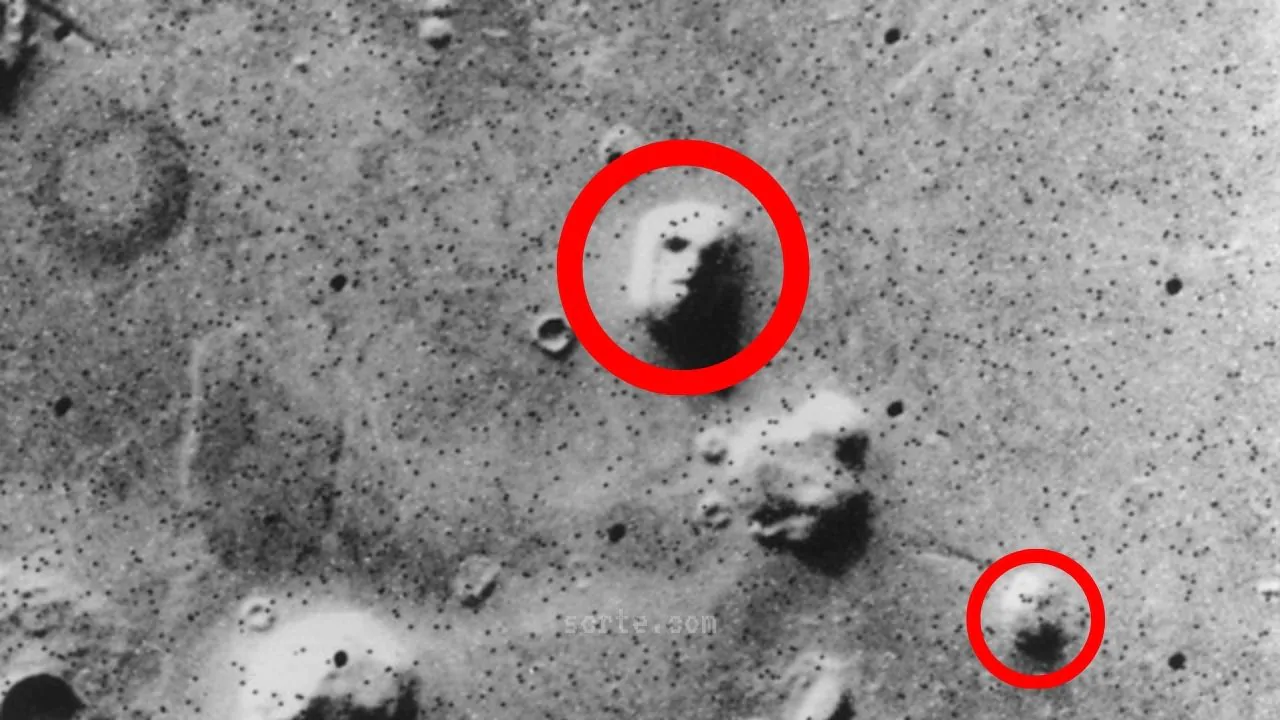
Viking 1 orbiter:
On July 25, 1976, NASA's Viking 1 orbiter captured an image of the Cydonia region showing a formation that strikingly resembled a human face. NASA scientists described it as a "trick of light and shadow," but conspiracy theorists saw something else: evidence of an ancient Martian civilization.
The "Face on Mars" became a cultural phenomenon, inspiring books, documentaries, and endless speculation. It appeared in the film "Mission to Mars" and became a rallying point for those who believe NASA hides evidence of extraterrestrial life.
Evidence:
The original Viking image shows clear facial features - two eyes, a nose, a mouth. The face appears symmetrical and deliberate, unlike random geological formations. It measures about 2 miles across - large enough to be a monumental sculpture visible from space.
Richard Hoagland, a former NASA consultant, became the face theory's most prominent advocate. He claimed the Cydonia region contains multiple structures arranged in geometric patterns, suggesting intelligent design. His books "The Monuments of Mars" and "Dark Mission" argue that NASA knows the truth but covers it up.Researchers using computer enhancement claimed to find other features in Cydonia - pyramids, a city complex, and a fortress. They argued the arrangement mirrored ancient Egyptian sites on Earth, suggesting a common extraterrestrial origin.
When NASA's Mars Global Surveyor reimaged Cydonia in 1998 and 2001 at higher resolution, the face appeared as an ordinary mesa. But conspiracy theorists cried foul, claiming NASA released degraded images or deliberately altered them.
"Facial features"
Later, higher-resolution images from multiple missions show the face as a natural geological feature - a butte or mesa common in the region. The "facial features" were created by low resolution, poor lighting, and human pattern recognition (pareidolia).Scientists at Malin Space Science Systems, who operate the Mars cameras, explained that the original Viking image had low resolution and the sun was low on the horizon, casting long shadows that created the illusion of features. When imaged with the sun higher, the "face" disappears.The human brain is wired to recognize faces - we see them in clouds, toast, and rock formations. The Face on Mars is a classic example of pareidolia, not archaeology. No other evidence supports the idea of an ancient Martian civilization.