Skull and Bones Secret Society: Powerful Elite Network
Home > Secret Society > Skull and Bones
Oct 31 2025

Imagine a world where a handful of young men from one of America’s most prestigious universities are quietly chosen, sworn to secrecy, and then go on to populate the corridors of power. This is the story of the Skull and Bones secret society at Yale University and many ask: is it a genuine network of influence shaping governments and economies, or is it simply just another conspiracy theory? In this article, we’ll dive into the foundation, rituals, known members, and the swirling cloud of speculation that surrounds it providing you with a clearer view so you can decide for yourself.
What is the Skull and Bones secret society
Origins: Yale’s Shadowy Fraternity
Founded in 1832 by William Huntington Russell and Alphonso Taft, Skull and Bones emerged during a period when elite fraternities were shaping the intellectual and political future of America. It was formally registered under the Russell Trust Association, a legal entity that still owns the society’s headquarters a windowless sandstone building on Yale’s campus ominously known as “The Tomb.”
Inside “The Tomb,” legends tell of dimly lit halls filled with skulls, bones, and occult symbols, echoing whispers of ancient rituals. While Yale has several fraternities and senior societies, none has captured the public imagination like Skull and Bones.
The Symbolism and Aesthetic of Order 322
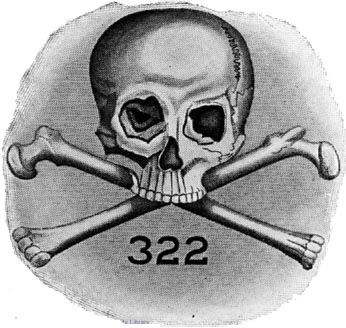
The society’s emblem a skull over crossed bones with the number 322 has inspired endless speculation.
Some say “322” refers to 322 BC, the year of Demosthenes’ death, symbolizing the fall of Greek democracy and the rise of oligarchic power. Others connect it to biblical numerology (Genesis 3-22), occult references, or even Masonic influences.
Beyond meaning, the aesthetic itself skulls, candles, Gothic architecture, Latin mottos has seeped into Dark Academia, occult fashion, and pop culture’s portrayal of secret power. From films like The Skulls to video games and streetwear, the Skull and Bones aesthetic represents both mystery and control, a powerful mix of fear and fascination.
The Rituals and Initiations: Myths, Legends, and Shadows
Every spring at Yale, 15 seniors are “tapped” selected to join the order. From that moment, they enter a world of secrecy that promises lifelong brotherhood.
Accounts from alleged insiders describe bizarre initiation ceremonies:
Members lying naked in coffins while confessing intimate secrets.
Rituals involving mock death and rebirth.
Oaths sworn over a human skull.
Though these stories come from former Bonesmen and journalists, none have ever been verified. Yet, it’s exactly this uncertainty that sustains the society’s mythos a blend of occult imagery and elite exclusivity that keeps the public enthralled.
Famous Skull and Bones Members: The Elite Within the Elite
If the legends ended at Yale, Skull and Bones might simply be an eccentric fraternity. But what keeps it in the global spotlight is its roster of alumni, many of whom rose to the highest echelons of power:
William Howard Taft — 27th President of the U.S. and Chief Justice of the Supreme Court.
George H. W. Bush — 41st President, former CIA Director, and Bonesman of 1948.
George W. Bush — 43rd President and Bonesman of 1968.
John Kerry — U.S. Senator and 2004 Presidential candidate (also a Bonesman).
Dozens of diplomats, financiers, judges, and media executives — many quietly linked through the Bones alumni network.
Coincidence or coordination? Critics see a pattern of power perpetuation, while defenders argue it’s simply a result of elite education and networking.
Skull and Bones vs. the Illuminati

Skull and Bones often finds itself mentioned alongside the Illuminati or Freemasons as part of a wider narrative of global elite secret societies that allegedly control political and economic systems.
Some claim the Bonesmen serve as the American branch of an international hidden power, guiding world events through influence rather than open control. Others see this as a reflection of modern anxieties projecting fears of inequality, corruption, and unseen governance onto convenient symbols.
While the Illuminati myth traces its origins to 18th-century Bavaria, Skull and Bones represents a uniquely American version of the same archetype: the secret brotherhood of privilege, secrecy, and unspoken power.
Ritual, secrecy and mythmaking
The combination of secrecy, ritualised initiation, exotic practices and prestige creates fertile ground for speculation. Stories of bizarre dining, hidden corpses, satanic overtones and elite control have circulated widely. These legends fuel the perception that this society might be “rulers of the world” rather than simply an exclusive club.
Global Power

Network of influence
The society claims an impressive roster of alumni: three U.S. presidents, numerous senators, business leaders, and intelligence figures. The journalist Alexandra Robbins described Skull and Bones as “the most powerful secret society in the U.S.”, pointing to the 2004 presidential race between George W. Bush and John Kerry — both noted as members.
Beneath its rituals and mystique lies a tangible structure: the Russell Trust Association, the legal foundation behind Skull and Bones. This entity manages real estate, investments, and assets used by the society giving it a financial backbone uncommon among college fraternities.
Some researchers argue that this trust serves as a financial link between members, supporting a network that extends into Wall Street, intelligence agencies, and government contracting. Others dismiss it as simply the administrative arm of a private student organization.
Once again, the truth lies hidden in layers part history, part myth, part mirror of the society that created it.
Symbols, Architecture, and Occult Parallels
The Tomb’s interior reportedly mirrors Egyptian tombs and Masonic temples, filled with esoteric objects from ancient armor to supposed relics like Geronimo’s skull (a claim denied but never disproven).
For enthusiasts of occult societies, these symbols echo traditions found in:
Freemasonry (ritual rebirth and secrecy).
Rosicrucianism (knowledge as enlightenment).
Hermeticism (hidden truth and transformation).
Yet, within the Gothic walls of Yale, these elements might simply serve theatrical, not mystical, purposes an elaborate performance of belonging for America’s future elite.
Reflection: Power, Privilege, and the Human Desire for Mystery
So what makes the Skull and Bones so captivating? Perhaps it’s not just its secrecy but what it symbolizes our collective obsession with power that hides in plain sight.
Maybe it’s easier to believe in shadowy brotherhoods than to accept that power is often diffuse, systemic, and born of privilege rather than conspiracy. Or maybe just maybe there really are rituals behind closed doors that shape the course of history.
As with all elite secret societies, the line between truth and legend is deliberately blurred — and that’s precisely how they endure.
Conclusion: The Mystery That Never Dies
Whether the Skull and Bones is an innocent fraternity, a gateway to the global elite, or a remnant of occult aristocracy, its allure persists because it invites reflection not just on what it hides, but on what we project onto it.
The truth, as always, lies somewhere between the documented facts and the collective imagination.
So the next time someone mentions Order 322, pause for a moment.
Ask yourself: Is this a symbol of hidden control or a mirror reflecting our fascination with secrecy itself?
- Are the Magnificent Seven Becoming AI Bubble Companies? A Deep Dive Into the 7 Tech Giants
- Flat Earth: Why Do Some People Believe Our Planet Isn't A Sphere?
- Illuminati: Do 13 Families Really Control Everything?
- TikTok’s Silent Takeover: How It’s Rewiring Your Brain in the Age of Digital Neuroscience
- What is a conspiracy theory? The psychology behind the belief