Popular Posts


Did the NSA Create Bitcoin? New Clues Reignite the Conspiracy Theories Behind Satoshi Nakamoto
Home > Conspiracies > NSA and Bitcoin
Oct 28 2025
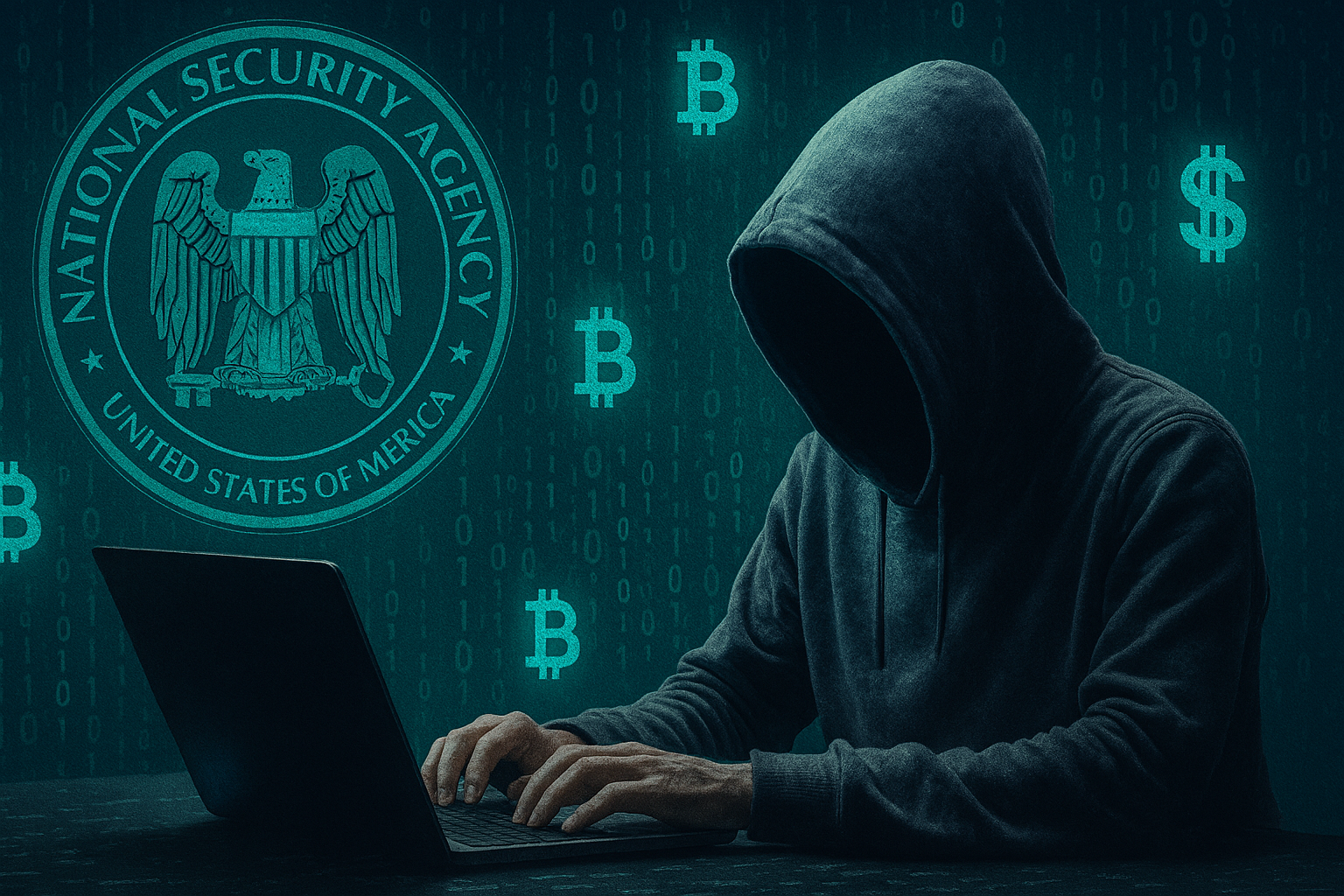
Since its mysterious appearance in 2008, Bitcoin has challenged the very foundation of global finance a decentralized currency built on trustless cryptography, promising financial freedom and digital sovereignty. But as the years passed, a chilling question began echoing through online forums and cryptographic circles: What if Bitcoin wasn’t created by a rogue genius but by the NSA itself?
This theory, once dismissed as internet folklore, has recently resurfaced with new documents, linguistic analyses, and cryptographic clues that force us to rethink what we thought we knew about Bitcoin’s origins.
Could the ultimate tool for financial freedom also be the most sophisticated surveillance mechanism ever built?
Let’s explore the evidence and the unsettling implications.
The Enigma of Satoshi Nakamoto
The name Satoshi Nakamoto first appeared in 2008, attached to a nine-page whitepaper titled “Bitcoin: A Peer-to-Peer Electronic Cash System.”
A year later, Bitcoin’s open-source code was released perfectly structured, elegantly coded, and using the SHA-256 cryptographic algorithm.
Then, in 2011, Nakamoto vanished without a trace. Over a decade later, no one has definitively identified Satoshi. But stylometric analyses — studies of writing patterns and syntax — have linked the whitepaper’s style to technical documents previously authored by U.S. intelligence researchers, particularly those linked to the National Security Agency (NSA). Coincidence or calculated design?
The NSA’s Cryptographic Fingerprints

One of the strongest arguments fueling the theory revolves around Bitcoin’s cryptographic foundation: SHA-256.
The Secure Hash Algorithm 256-bit, which secures Bitcoin’s blockchain, wasn’t invented by Satoshi. It was developed by the NSA in 2001 and standardized by NIST (National Institute of Standards and Technology).
That fact alone doesn’t prove collusion, after all, many encryption standards are government-born. But critics argue it’s the perfect Trojan horse: an NSA-designed algorithm underpinning the world’s most influential digital currency.
Some cryptographers argue that while SHA-256 appears secure, its internal mathematical structure could contain subtle backdoors known only to its creators. If true, the NSA could theoretically trace transactions, break pseudonymity, or even undermine Bitcoin’s core protocol without detection.
While there’s no direct proof of such a backdoor, the possibility aligns disturbingly well with the NSA’s historical obsession with global surveillance and cryptographic control.
The 1996 NSA Paper: A Hidden Blueprint for Bitcoin?
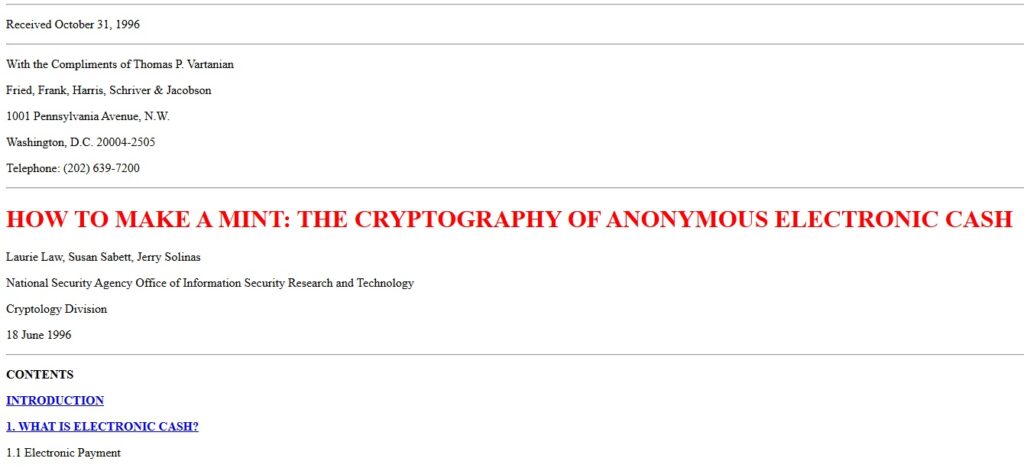
The new wave of speculation began when Daniel Roberts, co-founder of Iris Energy, shared screenshots of a 1996 research paper titled “How to Make a Mint: The Cryptography of Anonymous Electronic Cash.”
The authors? Researchers from the U.S. National Security Agency (NSA).
This little-known document outlines several principles strikingly similar to Bitcoin’s structure including public-key cryptography, anonymous transactions, and electronic cash systems resistant to double-spending.
In essence, it reads like a conceptual prototype of Bitcoin written over a decade before Satoshi Nakamoto’s whitepaper.
Even more curious: among the paper’s cited sources is Tatsuaki Okamoto, a Japanese cryptographer known for his work on zero-knowledge proofs and anonymous digital money. Some theorists point to the uncanny resemblance between “Tatsuaki Okamoto” and “Satoshi Nakamoto” suggesting that the pseudonym itself could be an intentional nod, a cryptic wink from someone aware of the paper’s origins.
A Tweet That Sparked a Storm
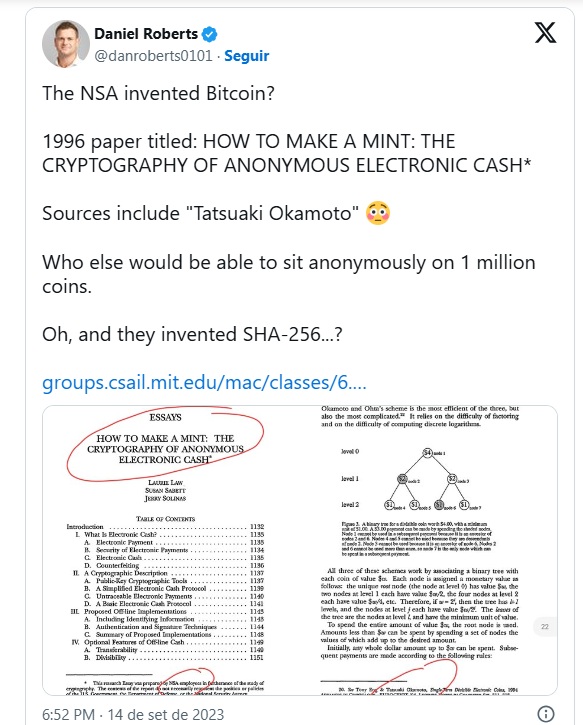
When Roberts posted the 1996 NSA document on X (Twitter), he added fuel to the conspiracy fire.
The post went viral reigniting one of the crypto world’s oldest suspicions:
If SHA-256, the cryptographic algorithm securing Bitcoin, was developed by the NSA in 2001, could the entire system be under their influence?
After all, SHA-256 forms the backbone of Bitcoin’s blockchain hashing every block, securing every wallet, validating every transaction.
Some argue that if the NSA truly wanted to insert a subtle backdoor, Bitcoin would be the ultimate playground.
Others counter that if the NSA could crack SHA-256, it would never expose that capability by attacking Bitcoin a move that would instantly reveal its cryptographic power.
For now, the debate remains theoretical. But the timing, authorship, and technical overlap are difficult to ignore.
The “Lab Leak” Hypothesis: Bitcoin as an NSA Experiment
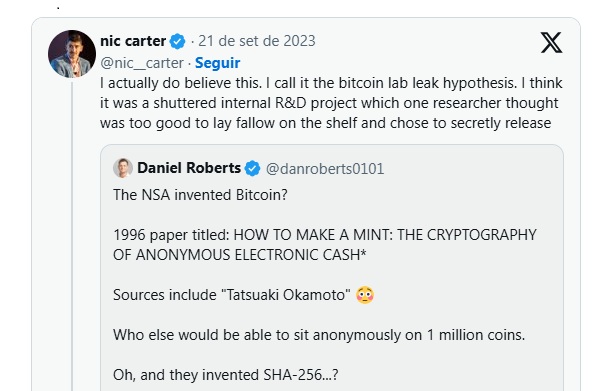
Among those fueling the discussion is Nic Carter, a prominent Bitcoin advocate and partner at Castle Island Ventures. Carter doesn’t dismiss the NSA theory outright instead, he reframes it. He calls it the “Bitcoin Lab Leak Hypothesis.”
In other words: Bitcoin may have started inside an intelligence lab as a proof of concept, later released by a rogue researcher inspired by the cypherpunk movement.
A creation intended for control repurposed for freedom.
Cypherpunks, Spies, and Cross-Pollination
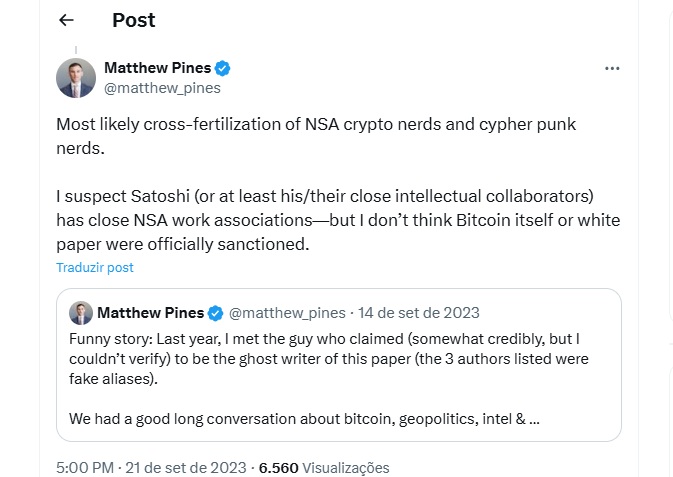
Another expert adding nuance to this discussion is Matthew Pines, a cybersecurity analyst at Krebs Stamos Group. He speculates that Bitcoin might have emerged from an intersection of two worlds NSA cryptographers and cypherpunk idealists.
This idea of “cross-pollination” is key: many early cryptographic pioneers who later became cypherpunks had formal or informal contact with intelligence institutions during the 1980s and 1990s. The boundaries between state research and underground innovation were often blurred.
The Anglo-American Connection: Raoul Pal’s Bold Theory

Former Goldman Sachs executive Raoul Pal took the idea further. He proposed that the NSA and the GCHQ the UK’s Government Communications Headquarters could have jointly developed Bitcoin, given their shared expertise in cryptography and digital espionage.
Such collaboration wouldn’t be unprecedented. The NSA and GCHQ have a long history of joint operations, from the Cold War’s “ECHELON” program to modern cyberdefense partnerships. Could Bitcoin have been a transatlantic experiment in distributed finance — one that outgrew its intended boundaries?
Other Theories: From Beijing to Beyond the Stars
While the NSA hypothesis dominates, it’s far from the only origin theory circulating online.
Some claim the Chinese Communist Party created Bitcoin to undermine Western finance and test decentralized control systems.
Others propose that extraterrestrial intelligence seeded the technology to accelerate human evolution toward digital societies. (Charlie Shrem)
A more linguistically playful theory argues that “Satoshi Nakamoto” is a code — where Satoshi means “wise” and Nakamoto means “central” in Japanese — thus hinting at “Central Intelligence,” or CIA.
Each version adds another layer of myth to Bitcoin’s already legendary status proof of how powerfully it captures the imagination at the crossroads of technology, secrecy, and ideology.
The 2013 NSA Document Leak and Snowden’s Shadow

In 2013, Edward Snowden revealed a trove of NSA documents detailing extensive digital surveillance operations. Among them were files showing the agency’s deep involvement in monitoring encryption technologies, Tor networks, and the Deep Web.
One lesser-known document described the NSA’s internal project on “cryptocurrency tracking” and its capacity to deanonymize Bitcoin users via blockchain analysis combined with IP tracing.
If the NSA was capable of tracing Bitcoin activity within five years of its creation, what does that say about its potential role in the system’s architecture from the start?
Could Bitcoin’s “anonymity” have always been a calculated illusion?
Stylometric Evidence and Linguistic Patterns
Independent researchers have used stylometric analysis a form of authorship fingerprinting to compare Nakamoto’s writing with other known technical authors.
Some analyses found eerie similarities between Satoshi’s linguistic tone and writings from Lawrence Livermore National Laboratory and NSA-affiliated whitepapers from the early 2000s discussing peer-to-peer encryption frameworks.
Even the term “proof-of-work”, central to Bitcoin’s design, was coined in 1999 by two researchers with ties to U.S. defense projects.
Again, none of this constitutes proof but it forms a pattern. A web of linguistic, technical, and conceptual overlaps that refuse to fade with time.
A Digital Currency or a Digital Trap?

Let’s entertain a provocative hypothesis: What if Bitcoin was not a rebellion against state power, but a state experiment to study decentralized systems a live testbed for digital control under the guise of freedom?
It wouldn’t be the first time intelligence agencies planted disruptive technologies to observe societal reactions. The internet itself began as ARPANET, a DARPA project for military communications. Why not Bitcoin as a financial ARPANET?
Such a possibility invites reflection, not certainty. If Bitcoin was designed as a government tool, its evolution into a symbol of financial resistance would be an irony of historic proportions the creation escaping the control of its creators.
Bitcoin’s Architecture: A Double-Edged Sword
Even if the NSA didn’t create Bitcoin, it’s undeniable that Bitcoin’s architecture aligns with state surveillance interests in unexpected ways:
Blockchain transparency: Every transaction is public and permanent. Perfect for forensic tracing.
Pseudo-anonymity: Not true anonymity; wallet addresses can often be linked to real identities.
Centralized mining pools: A handful of powerful entities now control much of Bitcoin’s hash power.
Network monitoring: Agencies can intercept node traffic and track IPs using sophisticated pattern analysis.
Yet, paradoxically, these same traits make Bitcoin a symbol of resistance to censorship, enabling activists, journalists, and dissidents to transact freely beyond traditional banking systems.
Bitcoin, in this light, becomes both sword and shield an instrument of surveillance and liberation.
The Geopolitical Chessboard

Governments around the world have long recognized the disruptive potential of cryptocurrencies. Some see them as tools of freedom; others as instruments of chaos.
In 2018, U.S. intelligence reports described Bitcoin as a “strategic observation vector”, allowing agencies to monitor global financial flows outside conventional banking systems.
Meanwhile, rival states like Russia and China began developing their own state-backed digital currencies more centralized, more traceable, more controllable.
The result? A new cyber-monetary arms race, where Bitcoin stands at the crossroads of privacy, power, and politics.
Between Myth and Reality
Skeptics Push Back: The Open-Source Counterargument
Was the NSA behind Bitcoin? The evidence remains circumstantial, the motives ambiguous.
But the question itself is what makes the story so captivating. It reveals a deeper truth about our digital age that trust and transparency have become intertwined with paranoia and power.
Whether or not the NSA played a direct role, the very fact that such a theory feels plausible speaks volumes about how we perceive technology, privacy, and control in the 21st century.
For every conspiracy believer, there’s a cryptographer who rolls their eyes. Skeptics point out that Bitcoin’s open-source nature directly contradicts the idea of hidden state control.
Every line of Bitcoin’s code is public. Every change is logged. Every node verifies every transaction.
If there were a cryptographic backdoor, it likely would have been discovered long ago by the thousands of independent developers and researchers who’ve audited it.
To many, the NSA theory simply overestimates the agency’s omnipotence and underestimates the decentralized resilience of the global developer community.
Still, even skeptics admit one thing: the mystery surrounding Satoshi Nakamoto’s disappearance — and the one million untouched Bitcoins attributed to him — continues to fuel endless speculation.
Trust, Surveillance, and the Irony of Decentralization
The idea that Bitcoin might have been born from the same institutions it seeks to oppose is rich with irony.
If the NSA truly helped birth Bitcoin whether by accident, experiment, or inspiration then the world’s most powerful surveillance agency inadvertently created the most effective tool for financial resistance ever invented.
That’s the paradox at the heart of this debate:
A system designed to resist censorship, possibly conceived by masters of control.
A symbol of freedom, built on code written by the very architects of global surveillance.
It’s a digital ouroboros the serpent eating its own tail.
Between Secrecy and Speculation
At its core, the question “Did the NSA create Bitcoin?” is less about proof and more about perspective.
It reflects our collective discomfort with invisible power and our instinct to seek patterns in the code, to find human fingerprints behind the algorithmic veil.
There’s still no definitive evidence linking the NSA to Bitcoin’s creation. Yet the connections from the 1996 paper, to SHA-256, to linguistic parallels, to cryptographic crossovers remain too intriguing to dismiss entirely.
In a digital world where surveillance and freedom coexist in uneasy tension, it’s no wonder such a story refuses to die.
Conclusion: Does It Even Matter Who Created Bitcoin?
Perhaps the more profound question is not who created Bitcoin, but why we care so deeply about knowing.
Bitcoin’s open architecture means it no longer belongs to any individual, institution, or nation. It is both a product of human ingenuity and a challenge to human control.
The truth behind Satoshi Nakamoto may forever remain hidden. But the mystery itself continues to shape the narrative of our digital age reminding us that in the quest for freedom, anonymity is both weapon and warning.
Bitcoin was born as a “trustless” system yet its origin demands our deepest trust:
- We trust an anonymous creator.
- We trust an algorithm built by a surveillance agency.
- We trust that decentralization means freedom.
But perhaps the real genius of Bitcoin is not in who created it, but in how it evolved a tool designed for control that became a weapon for autonomy.
Whether Satoshi was a lone cryptographer, a government lab, or something in between, one truth endures: Bitcoin forced humanity to confront the tension between privacy and power and that conversation is far from over.